Uncategorized
Reading Listed Dimensions: A Worksheet Beyond the Photograph
Start with the number, unit and measured part
Listed dimensions identify a stated measurement, its unit and the part it describes. A photograph can help you read a listing, but it does not fill in a missing unit or an unexplained measurement label. Use a small worksheet to separate what is stated from what still needs clarification.
For adults researching personal-wellness items, the useful question is not how large something looks. Ask which measurement the description actually names. If a photograph contains a labeled measurement, record that label too. If it contains no measurement information, leave that field unanswered rather than inventing a value.
Make a five-field dimension worksheet
For each listing, read the description alongside the fine print and record the exact model or version before making the worksheet. Work through one dimension at a time, keeping the original wording beside any calculation so you can return to the seller's statement.
- Item identity: the model or version named in the listing. Do not merge notes from similar names.
- Measurement label: copy the stated feature, such as overall length or package width. Do not replace it with your own interpretation.
- Original value and unit: copy both together, including any stated approximation or range. A bare number is an unresolved field.
- Measurement scope: note any stated endpoints and whether the value describes the item, a component or its packaging.
- Source and question: record the listing URL, date and the detail you still need explained.
Convert the unit without changing the claim
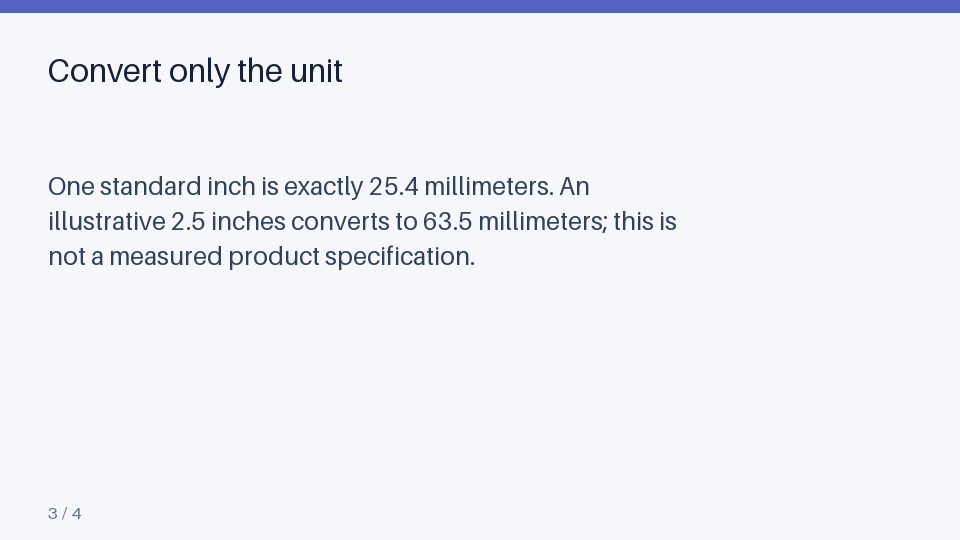
NIST states that one standard inch is exactly 25.4 millimeters and that 10 millimeters equal 1 centimeter. To convert an inch value to millimeters, multiply by 25.4; to reverse that calculation, divide by 25.4.
Here is an expressly illustrative example, unrelated to any actual product: a worksheet lists overall length as 2.5 inches. The conversion is 2.5 × 25.4 = 63.5 millimeters. Check it backward: 63.5 ÷ 25.4 = 2.5 inches. These numbers express the same length in different units; they are not evidence that two items are identical.
Keep the supplied value and the converted value in separate fields. An exact conversion factor does not tell you how the seller obtained the original measurement. Preserve any approximation attached to the listing instead of turning your calculation into a claim of tested precision.
Check three common comparison errors
First, check the unit before comparing the numbers. In the illustrative example, 2.5 inches and 63.5 millimeters do not describe different lengths just because the numbers differ. Second, check the feature label: package width and item width are separate statements. Third, check the item identity before combining a diagram, description and specification table.
If those sources disagree, do not average the values or select whichever sounds preferable. Keep both statements in your notes and ask which one applies to the exact item. Conversion resolves a unit difference; it cannot resolve an unclear label or conflicting source.
Turn the remaining gap into a precise question
A useful question is: Does the listed width describe the item or its packaging, and where is that measurement taken? Include the item identifier and the wording you are asking about. This worksheet interprets published information; it does not establish personal fit, performance or a measured specification for any particular item.